

The BUILDINGS
+ Amenities
A brief overview of each major building
or facility at the World Tech Center's impressive campus.

The TWIN TOWERS
Technology North Tower
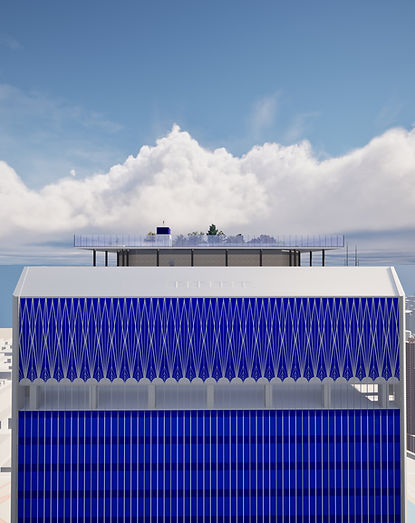
The Technology North Tower is conceived as the campus’ hub for information, and industrial and digital technology. Across its 110 stories, the building would house state-of-the-art laboratories for physics and electronics design, software development workshops, high-fidelity simulation and supercomputing facilities, and lecture rooms in which software engineers, physicists and data scientists develop and collaborate on new applications. The tenant mix is intended to be deliberately dynamic, spanning small start-ups and industry giants alike, from video game developers to aerospace and automotive design houses. The building would be dedicated to the electrical pioneer Nikola Tesla whose alternating-current polyphase system, induction motor and radio- frequency research underpin the modern world of electricity.
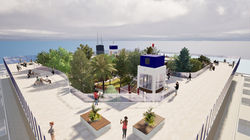
Perched at the top is the 1500ft high Open Heavens Observation Deck - the highest outdoor viewing platform and garden in the Western Hemisphere. Open Heavens would be Chicago's latest and unique tourist attraction providing a refreshing experience with uninterrupted views of the sky. It would be comprised of two levels:
1) The nature floor - a magnificent garden space featuring a variety of plants, shrubs and trees; with the addition of a mini food cafe and a stage for live performances.
2) The upper platform with a glass perimeter - a vantage point for spectators to admire the city, sit down and relax under the stars, or watch the sunset in serenity.
 |  |
|---|---|
 |  |
 |  |
 |  |
 |  |
 |  |
 |  |
 |  |
 |  |
 |
Science South Tower
Immediately adjacent, the Science South Tower complements its twin as the campus’ hub for general scientific research, cleanroom laboratories, and art and design workshops. The dedication honors President John F. Kennedy whose commitment to tasking the nation of achieving a crewed lunar landing by the end of the 1960s — and that charge be the United States chooses to do such things “not because they are easy, but because they are hard”. This remains the defining modern statement of public scientific ambition. As a nexus for discovery and innovation, the building would provide lecture and meeting rooms for teaching and networking, alongside general sciences laboratories, cleanrooms, and offices for prestigious national and international institutions. Candidate tenants identified during concept development include:
-
University of Illinois, Chicago (UIC)
-
Purdue University
-
American Society of Mechanical Engineers
-
American Iron and Steel Institute
-
American Society of Civil Engineers
-
The Royal Society of London for Improving Natural Knowledge
-
Royal Aeronautical Society (RAeS)
At the top is a massive dining restaurant. Christened Wonders of the World, it would reincarnate the Windows on the World from the original World Trade Center.
The pinnacle of it all - the spire - rises to 1969 feet. As a representation of the year humans first step foot on another celestial body (on Apollo 11), the largest waving Flag of the United States shall be raised tall and proud, and would symbolize America's leadership in exploration and discovery.

 |  |  |
|---|---|---|
 |  |  |
 |  |  |
 |  |  |
Surrounding FACILITIES
Physics & Engineering Building
The Christa McAuliffe Physics and Engineering Building would be a 10 story powerhouse for practical learning projects and student industry apprenticeships. It will be quipped with sophisticated laboratories that can manage multi-discipline space science experiments.
An array of cleanrooms of varying sizes provide space for assembling satellites, major student projects, inventions, and advanced machinery. Additional office and learning facilities would facilitate an ideal environment for professional bodies including:
-
The Leibniz Institute of Mathematics (LIM), a proposed foundation aiming to revolutionize math education with intuitive, engaging methods with AI augmentation.
-
Challenger Learning Center for Space Science Education
-
Aerospace engineering apprenticeship providers and others
A rooftop garden brings ample green space for the wellbeing of the tenants and includes a small restaurant.


Chemistry & Biological Sciences Building
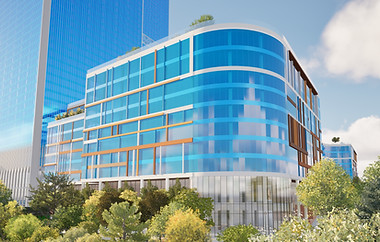
The F. Story Musgrave Chemistry and Biological Sciences Building is another 10-story facility that would focus on chemical engineering, medicine, and biological sciences. It will have the latest in sophisticated chemical and medical-grade laboratories and workspaces where industry professionals and talented students gain vital skills in chemistry and medicine. There will also be quantum computing facilities for research and devleopment in:
-
General microbial biology,
-
Cancer and disease research
-
Materials science to develop new super-alloys, metamaterials and sustainable products, and
-
Industrial process improvement
Complimenting its sister building would be another rooftop green space and balconies overlooking the plaza for the wellbeing of the tenants.
Government Workshop Building
The John H. Glenn Jr. Federal Building (also known as the Government Workshop Building) is a unique 10-floor workspace hub that would unite national and international government bodies. Named in honor of the first American to orbit the Earth, the facility serves as a direct link where regulation works smoothly with innovation - providing authorities an efficient path to support, supervise, test, audit, and certify new technology; ranging from new aerospace software and automation to AI and medicine. Candidate tenant agencies include (but not limited to):
-
Federal Aviation Administration (FAA)
-
U.S. Chemical Safety and Hazard Investigation Board (CSB)
-
National Aeronautics and Space Administration (NASA)
-
National Transportation Safety Board (NTSB)
-
National Institute of Standards and Technology (NIST)
-
International Civil Aviation Organization (ICAO)
-
Federal Trade Commission (FTC)
Cabinet-level government departments such as:
-
Defense (DoD)
-
Agriculture (USDA)
-
Health and Human Services (HHS)
-
Homeland Security (DHS)
-
Department of Energy (DoE)
-
Housing and Urban Development (HUD)
In this collaborative environment, staff would support and advise students and industry firms directly within the World Technology Center and foster a streamlined path to compliant standards within a reasonable time period.
With direct assess to talented people from around the world, authorities would greatly benefit from learning new ways to investigate and solve industrial, chemical and aviation accidents and incidents.


Computer rendering (top) and SketchUp CAD model (bottom)
The Discovery Hotel

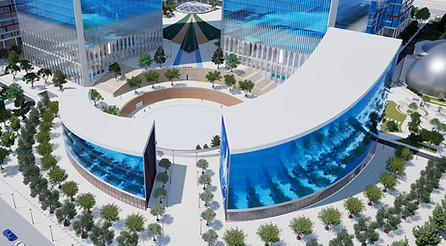
Comprising the North and South Blocks that rise from four to twelve stories, the Discovery Hotel is the campus's hospitality anchor — a sleek, curved, four-star establishment offering a space-themed experience in the idiom of science-fiction retrofuturism. The hotel encircles the Minoru Yamasaki Circle, its concave frontage forming the architectural frame of that public space; and at its entrance a model replica of the Space Shuttle Discovery would stand on permanent display. It would be an immediate, photographable statement of the fundamental character of the campus.
The word itself is part of the human psyche that describes creativity and exploration. It is referenced heavily in space exploration and popular culture. The OV-103 Discovery, the most-flown orbiter in the space shuttle fleet that twice made the return-to-flight missions (after the Challenger and Columbia disasters), and the USS Discovery One in Stanley Kubrick and Arthur C. Clarke’s 2001: A Space Odyssey, are an apt patron for a building dedicated to travelers.
Guest amenities are planned to include a restaurant, a gymnasium, a sauna and an indoor swimming pool, with interiors that carry the retrofuturistic hard sci-fi decor through guest rooms and public areas alike.
The Radio Music Venue
The Radio Music Venue (as the name implies) is a performing arts venue that is shaped like a cute ellipsoid Radio. Located directly in front of the Technology North Tower's northern entrance, It would host a variety of music events (such as an orchestra) and graduation ceremonies.

AMENITIES
Richard P. Feynman Plaza
"The only way for deep happiness is to do something you love to the best of your ability"
— Richard Feynman

This magnificent Art Deco plaza, dotted with trees, warm lamps and fountains will give the campus its signature nature-focus theme.
It is named after the legendary Nobel Prize-winning physicist (1918-1988) who was renowned for his pioneering work in quantum electrodynamics (QED), the development of mathematical tools called Feynman diagrams to visualize particle interactions, and his unconventional, brilliant teaching style. He was a key figure in the Manhattan Project; a popular science communicator; and a key investigator on the Rogers' Commission tasked to look into the cause of the Space Shuttle Challenger disaster.
The signature pattern is designed to resemble a fountain pen's tip, representing the place where new discoveries and knowledge are written. STEM sculptures such as molecules and the globe would be on display.


The American Library of STEM
The American Library of STEM is a planned multi-level library beneath plaza level, designed to be a knowledge sanctuary for science, technology, engineering, and mathematics.
Inspired by the Toronto Reference Library in Canada, it features a distinctive skylight that illuminates the interiors, creating a vibrant reading environment. The library will house practical collections, including engineering drawings, historical literature, and current journals, catering to students and apprentices. Located at the plaza's western entrance amid chemistry and engineering buildings, it symbolizes the foundational role of documented knowledge in the larger campus endeavor.
Hand-drawn sketch of the Interior
The Neil A. Armstrong Atrium
In between the Physics and Government Workshop buildings at the complex’ south face is a 60-meter-high arched atrium adorned with glass, brick, brown and white granite/marble and colorful metal trim. Drawing its design language from cathedral architecture, the atrium's layout features large transepts between the buildings that focus upon a central nave with entrance stairs, while indoor plants and trees flourish amongst the glass beneath overhead walkways — a deliberate marriage of the sacred architectural tradition with the secular pursuit of knowledge.
The atrium is named after Neil Alden Armstrong, the first human being to walk on the Moon. His not so well-known words: “Knowledge is fundamental to all human achievements and progress. It is both the key and quest that advances mankind” would be inscribed upon the entrance wall. The atrium serves as the main entrance to the campus from the southern end.


Yamasaki Circle + Gardens
Immediately northeast of the Feynman plaza is the Minoru Yamasaki circle, which forms the entrance pedestrian area to the World Technology Center Twin Towers. Named in tribute to the original architect of the World Trade Center (1912-1986), this zone will feature a large circular plaza with a spiral ramp (leading to the mall lower level and Discovery Hotel). Hosting seasonal events; in summer an outdoor barbecue eating area, and in winter the swift conversion into a stunning ice skating rink that brings the spirit of the New York Rockefeller Center to the City of Chicago.
A variety of beautiful garden space (with park amenities) will adorn the campus throughout, where nature offsets the concrete jungle.
 |  |  |
|---|---|---|
 |  |  |
 |  |  |
 |
The Mall
Beneath the plaza would be bustling with activity with the World Technology Center's subterranean shopping mall, a retrofuturistic consumer experience inspired by 2001: A Space Odyssey.
It will link all atriums and building lobbies with a diverse array of shops and eateries. There would also be two large grocery stores Aldi and Lidl.
The mall's architectural signature is expressed in a central underground 5 story atrium with a patterned glass dome, providing plenty of daylight into the underground space by the shining blue giants overhead.
There would also be a CTA blue line subway extension and station serving the World Tech Center, connecting the campus to the rest of the city with efficient underground transportation.

Flagship Apple Store
Inspired by the glass cube on Fifth Avenue, the World Tech Center in Chicago would boast a cylindrical glass Apple store at its western entrance - adding to the company's portfolio of flagship shopping locations.


Conceptual SketchUp model
Miscellaneous and Underground Facilities
The lowest subterranean levels will support major HVAC equipment, Data Servers, and Hydrogen Fuel cells for power generation. Just north of the dual block hotel and besides The Radio would be truck ramps leading to the logistics delivery zone and a new USPS vehicle maintenance facility to replace the one that would be demoloshed to make way for the campus. In addition, underground parking lots would be providided for essential personnel. All in all, five underground storeys will reach 28 meters deep and resting on bedrock.
The south redevelopment incorporates a new replacement, purpose built Tesla car dealership, and revamped landscaping and park space surrounding the existing Portillos restaurant and fast food drive-thru just souh of the Neil Armstrong Atrium.


